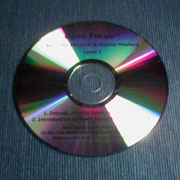
This program describes the circumstances out of which the originator of the OPEN FOCUS attention training process experienced his kidney stone pain and witnessed the importance of how he paid attention to it. The various types of attention are accessible by persons who practice the programs of attention training which are presented on the following tapes and CD’s. The most impactful of these circumstances is associated with a dramatic, instantaneous dissolution, complete elimination of pain, for example, kidney stone pain.

Racquet Sports Training – Level #3 Exercise #5
NOTE: This downloadable product is a ZIP file. Please extract it using an archive extraction program.
Listening In Open Focus – Level #3 Exercise
NOTE: This downloadable product is a ZIP file. Please extract it using an archive extraction program.
Independent Practice of Open Focus – Level #3 Exercise #6
NOTE: This downloadable product is a ZIP file. Please extract it using an archive extraction program.
How Am I Now Paying Attention – Level #2 Exercise #5
NOTE: This downloadable product is a ZIP file. Please extract it using an archive extraction program.

Roles of tradition, convenience, and noise or artifact rejection are discussed with regard to the monopolar versus bipolar electrode placement controversy in electroencephalography (EEG). Particular emphasis is placed on the relevance to biofeedback. The crucial interactions between the differential amplifier, brain waves, and monopolar/bipolar placements are discussed. Through logical analysis and empirical observation, it is demonstrated how the very nature of the EEG’s differential amplifiers must destroy elements of brain activity which are common to the recording electrodes. Controlled experiments further illustrate the critical importance of electrode placements. Various methods, including preferred electrode placements, are presented to help resolve recording problems that frequently arise. It is concluded that there are serious implications for researchers, EEG clinicians, biofeedback providers, and their clients in preferring one type of electrode placement technique over the other. EEG recording accracy is affected by this choice.
Does step-care treatment of hypertension increase cardiovascular risk and mortality?
This article looks at the experience of Frankie, an autistic 8 1/2 year old boy. He was diagnosed mildly autistic by several specialists. One specialist claimed he was brain damaged and “autistic-like” and that there was no hope for improvement. At Frankie’s mothers request, neurotherapy diagnosis and treatment was begun. After 31 sessions, Frankie showed positive changes in all the diagnostic dimensions defining autism in DSM-III-R. This has profound implications for treatment in a field with few low-risk alternatives
The way we pay attention directly affects our bodies and minds. Two scientists not only describe open focusing, they also show how to do it.